
Why Tour Businesses Are Losing Customers to AI Search (And How to Fix It)
Travelers now ask ChatGPT and Perplexity for tour recommendations before they ever reach Google. If AI never cites you, you lose the booking first.
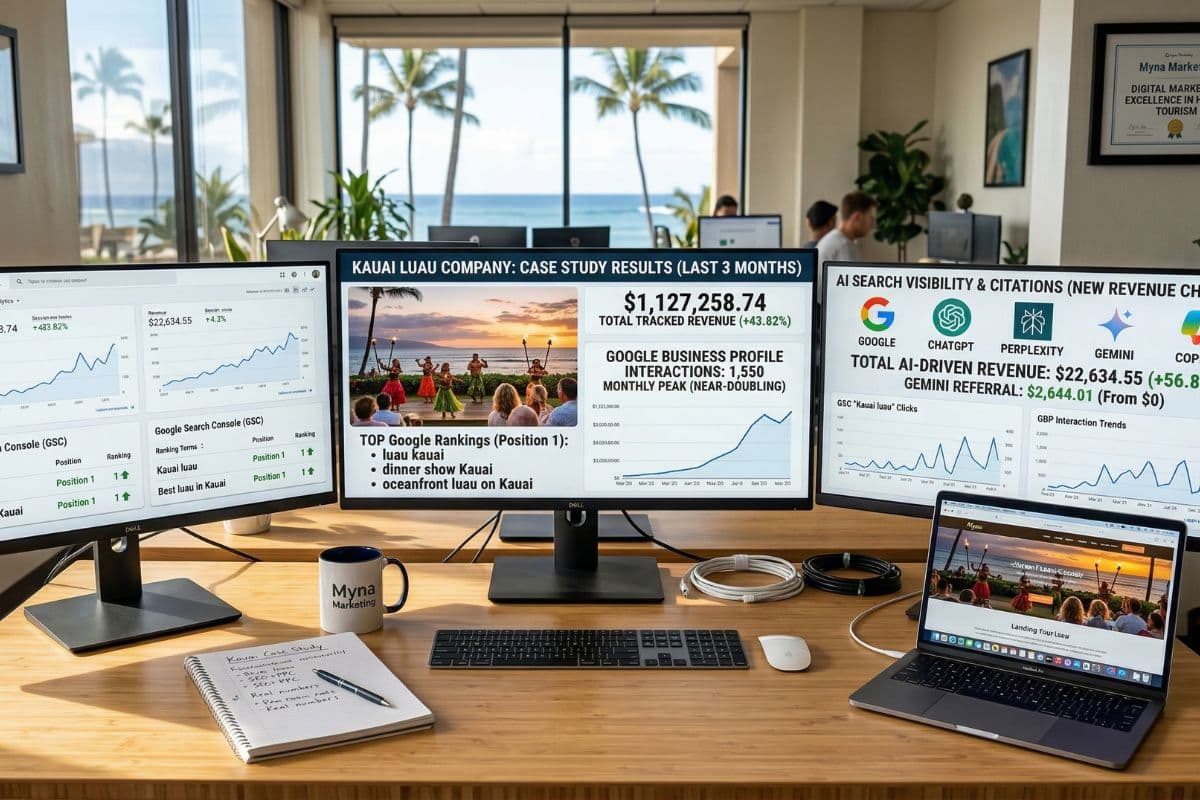
Tour businesses are losing customers to AI search because travelers now ask ChatGPT, Perplexity, and Google AI Overviews for recommendations before they ever reach a traditional search results page, and if those engines do not cite your business, the booking goes to a competitor that was cited. The traveler never sees your site, and you never see the lost booking. The fix is to structure your content so answer engines can extract, trust, and recommend you, a practice called answer engine optimization.
This is happening quietly, which is what makes it dangerous. You are not seeing a sudden drop in a report. You are seeing bookings that simply never arrive, because the decision was made inside an AI answer you were never part of.
How travel decisions actually start now
Picture a traveler planning a trip. A year ago, they opened Google, searched "best tours in [destination]," and scrolled a list of links, including, hopefully, yours. Today, a growing share of those same travelers open ChatGPT or Perplexity and ask "what is the best tour for a family visiting [destination]" or "recommend a half-day tour for first-time visitors." The AI returns a confident, conversational answer naming a few specific businesses and citing its sources.
If you are one of those cited businesses, you just earned a high-intent traveler who is already trusting the recommendation. If you are not, you are invisible at the exact moment the decision is forming, and no amount of traditional ranking saves you, because the traveler may never reach the page where your ranking lives.
How AI search decides who to recommend
Answer engines do not browse and rank the way Google's classic results do. They retrieve, evaluate, and cite. A few factors decide whether your tour business makes it into the answer.
First, structure. AI engines favor pages that answer a question directly, use clear headings, and include question-and-answer sections. Content that states facts plainly and is easy to extract gets cited; vague marketing copy that never actually answers a traveler's question gets skipped.
Second, trust signals across the web. AI engines weigh whether your business appears consistently across credible sources: reviews, directory listings, and mentions on sites they already trust. A tour business with a complete profile, consistent listings, and steady recent reviews reads as a real, trustworthy entity. One with a thin, inconsistent footprint does not.
Third, freshness. Pages updated recently earn the large majority of citations for the kind of "best of" and "recommend a" questions travelers ask. A site that has not been touched in two years reads as stale to an engine deciding who to trust right now.

Why tour operators are especially exposed
Travel is one of the categories where AI search is moving fastest, because travel questions are exactly the kind AI answers well: open-ended, recommendation-shaped, and research-heavy. Travelers ask for the "best," the "most family-friendly," the "hidden gem," and AI engines love to answer those with a curated short list.
That means the exposure is higher for tour operators than for many other local businesses. A plumber gets found in an emergency search that AI rarely intercepts. A tour gets found during a planning phase that AI now dominates. If your competitors are cited in those planning-phase answers and you are not, you lose the booking before the traveler ever compares prices or reads a single review on your own site.
How to fix it
The good news is that most tour operators have not optimized for AI search at all, so the field is wide open for the ones who move first. Here is what actually moves the needle.
Start by becoming your own customer. Open ChatGPT, Perplexity, and Google AI Mode and ask the questions your travelers ask: best tour in your category, what to do for a first visit, recommendations for families or couples. Note which businesses get cited. Those are your real competitors in the AI layer, and they show you the structure the engines reward.
Then restructure your key pages. Lead each one with a direct answer to the question it targets. Add FAQ sections that answer the real questions travelers ask, and mark them up with FAQPage schema so engines can read them cleanly. Make sure your core facts, what you offer, where, for whom, are present as structured data, not buried in an image or a booking widget the AI cannot read.
Keep it current. Freshness is one of the few signals you fully control, and it directly affects whether you are cited for the time-sensitive, planning-phase questions that drive tour bookings.
Build presence beyond your own site. Reviews, consistent directory listings, and mentions on travel and local sites the engines already trust all increase the odds that an engine names you as the recommendation. AI engines weigh that web of references heavily.

This is not a replacement for what you already do
Answer engine optimization does not replace your existing marketing, it sits on top of it. The same clean structure, fast load times, and schema that help you get cited by AI also strengthen your traditional search rankings and your paid search landing pages. You are not choosing between Google and AI. A well-built site, supported by Google Ads for the high-intent booking moments and custom AI systems to track which channel actually produces bookings, performs in all of them at once. The AI visibility layer is built on a strong foundation, not instead of one.
The window is open now
The tour operators who win the next few years are the ones building AI visibility while their competitors are still arguing about whether it matters. The retrieval behind these engines refreshes fast, so structural improvements can show up in AI answers within weeks, not the months traditional SEO often takes. That makes this one of the fastest visibility wins available, and one of the few where being early is a durable advantage.
If you want to know whether AI engines currently recommend your tour business, or recommend your competitors instead, a free audit of your visibility across traditional search, Google Business Profile, and AI answer engines is the clearest place to start. That is exactly the work we do at 4Pie Labs.
Frequently asked questions
Why are tour businesses losing customers to AI search?
Travelers increasingly ask ChatGPT, Perplexity, and Google AI Overviews for recommendations before they reach a traditional search results page. If those engines do not cite your business, the traveler often books a competitor that was cited, and you never see the lost booking.
How do I get my tour business recommended by ChatGPT and Perplexity?
Structure your site so answer engines can extract and trust it: lead pages with a direct answer to the question travelers ask, add FAQ sections marked up with FAQPage schema, keep content current, and build consistent third-party signals like reviews and directory listings. This is the practice of answer engine optimization.
How fast can a tour business start showing up in AI answers?
Structural changes often appear in Perplexity within roughly one to two weeks and in ChatGPT within a few weeks, because their retrieval refreshes faster than traditional search rankings. It is one of the fastest visibility wins available right now.